Discover why jasmine tea Vietnam has become the premier choice for global F&B chains with rich tea body, natural floral aroma, and optimized supply costs.
Global F&B brands are actively hunting for clean-label raw ingredients that retain natural aroma stability while cutting production costs. Under this market shift, jasmine tea Vietnam has quickly captured the full attention of international procurement directors. Beyond eliminating margin squeezes and rigid MOQ barriers from traditional hubs like mainland China or Taiwan, this product line delivers a distinctly robust tea body along with full compliance with global laboratory standards. Here is an in-depth breakdown showing why international beverage markets place strategic confidence in this supply base.
Strategic Standing of Jasmine Tea Vietnam in Beverage Base Teas and F&B
Jasmine scented tea consistently serves as the operational backbone of beverage formulation lines. As consumer preferences pivot sharply from synthetic flavor additives to pure botanicals, jasmine tea Vietnam acts as a prime competitive alternative for worldwide beverage chains.
The Reigning Base Tea
Jasmine tea claims an overwhelming share of base teas used in bubble tea recipes, fruit teas, and ready-to-drink (RTD) bottled beverages. The clean vegetal notes of green tea buds blend with delicate jasmine blossoms to create a balanced structure that never overpowers syrups, purees, or dairy components.
Market data from Grand View Research (Bubble Tea Market Size, Share & Trends Analysis Report, 2023–2030 update) reveals that jasmine green tea commands more than 38% of total raw base tea market share across the global bubble tea sector due to versatile application profiles. Parallel reporting from Mordor Intelligence (Global Tea Market - Growth, Trends, and Forecasts) shows that herbal and naturally scented teas achieve a compound annual growth rate (CAGR) of roughly 5.7% per year. Such pairing flexibility makes jasmine tea an indispensable standard for every beverage R&D team formulating core drink menus.
Demand Outpaces Supply for Naturally Scented Teas
The clean label movement has completely rewritten global procurement specifications. Consumers reject artificial flavoring agents and chemical preservatives, pushing F&B operators directly toward tea bases scented with fresh blossoms.
Research from Innova Market Insights (Trends Survey on Clean Label & Natural Ingredients) demonstrates that over 63% of global consumers proactively read ingredient panels to confirm "100% natural" claims. Fresh jasmine flower harvests occur only during specific seasonal windows each year. Preserving fresh floral aromatics across a 12-to-24-month shelf life without synthetic essential oils demands advanced technology alongside massive agricultural acreage. Processing infrastructure deficits across several producing nations have caused severe shortages of natural, commercially scalable scented teas.
The Operational Bottlenecks of Beverage Chains
Procurement directors face their steepest challenge in aroma retention and foundational flavor balance. Under high-volume industrial brewing or centralized batch cold-brewing at store level, artificial jasmine flavoring dissipates rapidly, leaving behind dry astringency or harsh bitterness.
If base tea leaves lack sufficient body, the finished beverage loses its distinct tea identity once combined with ice cubes, non-dairy creamers, or rich dairy. Multi-unit chains operating hundreds of doors cannot risk flavor variations between extraction cycles. Securing a stable supply of jasmine tea Vietnam delivers the dense tea body, gentle astringency, and deep-set natural aroma required to maintain standard flavor profiles across an entire franchise network.
Dual Margin Pressures and Supply Chain Hurdles from Legacy Origins for Jasmine Tea Vietnam
Historical overreliance on legacy jasmine tea producers exposes food and beverage operations to margin deterioration and inventory interruptions.
Monopolies and Escalating Costs in China and Taiwan
Mainland China (anchored by hubs like Hengzhou in Guangxi and Fuzhou in Fujian) and Taiwan have historically dominated global jasmine tea exports. Soaring upstream production costs have eroded this advantage.
Data published by the China Tea Marketing Association (CTMA) indicates that manual labor costs for harvesting jasmine flowers and tender tea shoots in Guangxi spiked over 45% between 2019 and 2024, driving Grade 1 jasmine tea FOB export pricing past 12 to 18 USD per kg. In Taiwan, annual statistics from the Agriculture and Food Agency (MOA) show that commercial tea farmland shrinks by 1.2% annually due to urbanization, pushing local scented tea quotes to 20 to 35 USD per kg. For industrial beverage manufacturers, these raw ingredient rates decimate operating margins.
Punitive MOQs and Shelf-Life Inventory Risks
Major exporters across Fujian and Taiwan frequently mandate severe minimum order quantities (MOQs). Securing competitive FOB unit prices often obligates buyers to lock into 5 to 10 metric tons per individual SKU.
For growing beverage chains or brands testing regional pilots, rigid MOQs lock up vital working capital while inflating cold-storage warehousing costs necessary to maintain floral intensity. When market conditions fluctuate or product turns slow down, bulk inventory runs the risk of oxidation, aroma degradation, and steep write-downs.
Freight Disruption Worries and the "China+1" Sourcing Model
Ocean container volatility, international trade renegotiations, and sudden tariff adjustments make single-country sourcing a substantial business threat. Supply chain analyses from McKinsey & Company (Risk, resilience, and rebalancing in global value chains) confirm that consumer goods enterprises actively restructure procurement around a "China+1" posture to blunt operational disruption.
Diversifying agricultural regions into Southeast Asia addresses geopolitical exposure. Jasmine tea Vietnam stands as an optimal sourcing hub to balance global pipelines, supported by vast agro-industrial output and streamlined maritime shipping networks.
Why Commercial Buyers Choose Jasmine Tea Vietnam Over Competing Origins
Far more than a short-term substitute, jasmine tea Vietnam wins procurement contracts through tangible commercial advantages and superior technical performance.
Clear Price Competitiveness
Competitive operational costs and concentrated plantation networks throughout Lam Dong, Phu Tho, and Thai Nguyen grant jasmine tea Vietnam a distinct cost advantage. Export FOB pricing for Vietnamese jasmine-scented teas routinely runs 20% to 35% below comparable sensory grades from mainland China, and up to 50% below Taiwanese lots.
These primary ingredient savings provide beverage operators with budget flexibility to fund customer acquisition campaigns, upgrade packaging, or increase net profit per unit sold.
Distinctly Full Tea Body
Master beverage formulators consistently select jasmine tea Vietnam for its dense mouthfeel and structural integrity. Vietnamese green tea tips, cultivated in the mineral-rich basaltic soils of the Bao Loc highlands (Lam Dong), carry a balanced ratio of polyphenols and amino acids.
A smooth, mild astringency followed by a lingering sweet aftertaste establishes an unyielding foundation. In milk tea or iced fruit tea recipes, the base profile holds firm against heavy condensed milk, fruit syrups, and meltwater dilution. This structural density separates jasmine tea Vietnam from aromatic teas that collapse into thin, watery drinks once served over ice.
Traditional Fresh Flower Scenting Methods
Local Jasminum sambac harvests take place by hand right as mature floral buds swell with essential moisture, primed to open fully in the evening for maximum aromatic release. Standard processing protocols for jasmine tea Vietnam layer fresh blossoms across multiple cycles with cold-dried green tea leaves.
Precise temperature and humidity controls across scenting rounds lasting several days draw natural floral oils deep into the leaf structure. Once processors separate the spent blossoms, the finished jasmine tea Vietnam retains a clean floral profile, free from chemical notes or scorched odors.
Adaptive MOQs and Custom OEM/ODM Capabilities
Unlike legacy processing centers, modern export manufacturers producing jasmine tea Vietnam provide flexible trade terms designed around partner growth. Tailored MOQ tiers support phased market entry via pilot quantities before scaling up to full container loads.
OEM/ODM programs allow buyers to modify blossom scenting ratios, dial aroma potency, build custom leaf blends, and design private-label packaging. These production capabilities give brands an accessible pathway to build distinct signature profiles for their menus.
Technical Parameters and Quality Control Standards for Exporting Jasmine Tea Vietnam
To integrate into corporate food and beverage supply frameworks, processing facilities handling jasmine tea Vietnam standardise operational criteria from farm to container.
Commercial Sensory Metrics
Licensed sensory evaluators screen every export batch of jasmine tea Vietnam through standardized cupping protocols:
|
Sensory Metric |
Quality Standard for Export Jasmine Tea Vietnam |
Commercial Value in F&B Applications |
|
Appearance |
Tightly rolled, uniform buds; natural olive-green hue; broken leaf fragments strictly under 3%. |
Promotes smooth extraction rates and prevents filter clogs in commercial brewers or manual tea sachets. |
|
Liquor Color |
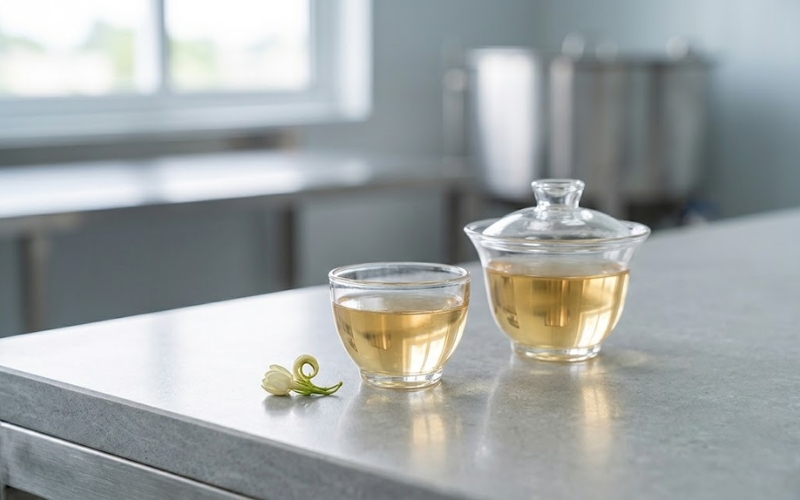
Bright, translucent golden-green infusion; clear with zero visible sediment or cloudiness. |
Delivers clean visual presentation in modern iced fruit teas and cheese-foam milk tea preparations. |
|
Aroma Profile |
Potent, pure, fresh jasmine bouquet; zero traces of smokiness, dampness, mold, or synthetic aroma additives. |
Sustains aromatic intensity throughout cold-steeping procedures and heavy ice-shaking protocols. |
|
Taste Profile |
Gentle initial astringency, dense tea body, and an immediate clean, sweet aftertaste in the finish. |
Forms an assertive foundation that resists dilution from dairy powders, condensed milk, or heavy purees. |
Pesticide Maximum Residue Limit (MRL) Management
Pesticide limits represent the most vital compliance hurdle in international agricultural trade. Acknowledging this requirement, the production infrastructure behind high-grade jasmine tea Vietnam has transitioned into managed GAP and biosafety farming cooperatives.
Field applications adhere strictly to authorized compound registries. Prior to export packing, certified third-party testing labs (such as Eurofins and SGS) inspect production lots of jasmine tea Vietnam. Rigorous multi-residue pesticide screens and heavy metal assays (lead, cadmium, arsenic) verify full compliance with US FDA parameters and European Union directives.
Global Processing Facility Accreditations
Top-tier industrial suppliers packaging jasmine tea Vietnam operate modern, enclosed facilities compliant with international safety benchmarks.
Automated lines maintain operational certifications under ISO 22000:2018 and HACCP hazard control programs, alongside dedicated Halal and Kosher audit compliance. Batch-specific Certificates of Analysis (COA) and Technical Data Sheets (TDS) accompany every export container, expediting customs clearance at global destination ports.
Reliable and Sustainable Sourcing Solutions for Jasmine Tea Vietnam
The growing international footprint of jasmine tea Vietnam unites agricultural resources, natural fresh flower scenting, and modern industrial testing. Delivering a firm tea body, reliable aroma retention, and a 20% to 35% landed cost advantage over legacy supply hubs, this raw ingredient resolves risk management hurdles while expanding margins. Sourcing jasmine tea Vietnam secures a decisive competitive foundation for beverage chains, import wholesalers, and ready-to-drink bottlers looking to protect their bottom line. Request a complimentary commercial sample kit, batch COA/TDS documents, and current export price matrices for premium jasmine tea Vietnam by emailing Viet Global Source at dat.nguyen@vietglobalsource.com. Our international logistics and sales teams stand ready to guide your custom blend development and streamline supply chain execution.