
The complete guide to black tea Vietnam: Grades, sensory profiles, wholesale procurement strategies, and logistics optimization for global F&B brands.
The global beverage manufacturing sector is navigating aggressive supply chain restructuring. Inflationary pressures, ocean freight volatility, and shifting climate patterns across traditional origins compel international buyers to diversify supply bases, defending operating margins while protecting finished product uniformity. In this environment, black tea Vietnam has emerged as a high-value strategic asset. Domestic processing facilities have transitioned rapidly beyond low-value bulk exports to adopt sophisticated technical processing standards capable of fulfilling specialized OEM and private-label contracts. Written from an international trade standpoint, this guide provides the technical data, market intelligence, and supply chain execution frameworks required by procurement directors, supply chain executives, and global F&B brand managers.
The Strategic Importance of Black Tea Vietnam in Global Beverages
Commercial Market Demand
The worldwide beverage sector is expanding primarily through ready-to-drink (RTD) bottled beverages and commercial boba milk tea chains. This structural shift creates massive industrial demand for tea bases with high soluble solids, deep liquor color stable across thermal processing, and the body required to carry fresh milk or non-dairy creamers without sensory degradation.
Trade statistics from Vietnam Customs and the Ministry of Industry and Trade confirm that Vietnam consistently ranks among the top five global tea exporters, shipping between 120,000 and 145,000 metric tons annually. Black tea comprises approximately 50% of this total export volume. Modern black tea Vietnam supplies are deeply integrated into major consumer markets: Taiwan and Southeast Asia procure tens of thousands of metric tons yearly for boba tea bases; the Middle East and South Asia consume massive volumes of strong traditional orthodox teas; while North America and the European Union import industrial volumes for continuous extraction lines.
Competitive Advantages Against Legacy Origins
Benchmarked against traditional powerhouses such as India, Kenya, and Sri Lanka, raw tea supplies from Vietnam deliver concrete commercial and operational advantages:
- COGS Reduction: Average export prices sit at 1,700 to 1,900 USD per metric ton, offering 25% to 40% cost savings compared to Kenya (2,400 to 2,700 USD/MT) or India (2,800 to 3,500 USD/MT).
- Extended Harvest Cycle: Northern tea regions harvest continuously from March through November, while the Central Highlands harvest year-round, eliminating seasonal supply cliffs.
- Shorter Ocean Transits: Ocean transit requires only 3 to 7 days from Hai Phong or Cat Lai ports to key East Asian destinations.
Direct access to major transpacific and regional maritime routes enables international importers of black tea Vietnam to shorten working capital cycles, cut inventory carrying costs, and avoid transshipment bottlenecks.
Grading and Flavor Profiles of Black Tea Vietnam
Procurement teams must align manufacturing specifications with exact mechanical processing categories and distinct regional terroirs.
Mechanical Processing Classifications
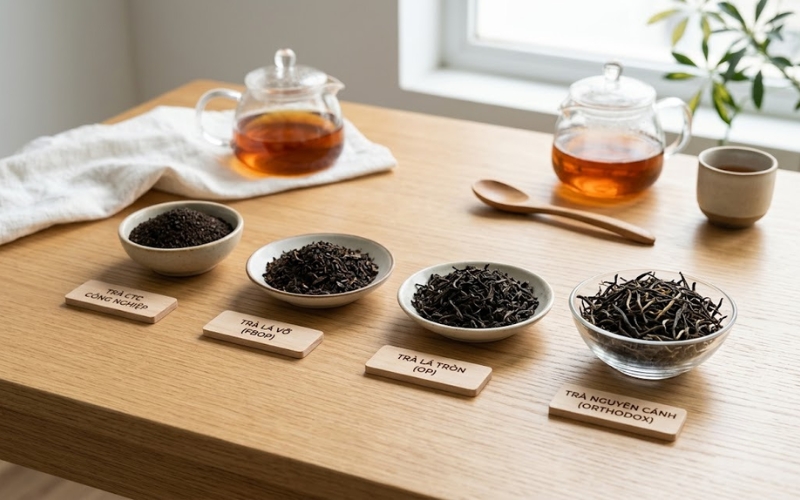
Vietnam's export infrastructure splits raw leaf processing into two core methodologies: Orthodox (traditional roller processing) and CTC (Crush, Tear, Curl).
Orthodox processing uses gentle withering and mechanical rolling to preserve leaf integrity before controlled oxidation and drying. The output is sorted into standardized international particle grades: OP (Orange Pekoe), offering long, slender leaves with bright amber liquor; PEKOE, yielding thick, tightly curled leaves with rounded briskness; FBOP, containing broken leaves and silvery tips with natural honeyed notes; and BOP/BOPF, featuring uniform broken particles ideal for premium tea bags and milk tea blending.
CTC processing uses counter-rotating grooved rollers to cut, tear, and curl fresh green leaf into dense, uniform spheres:
|
Tea Grade |
Particle Size and Body Profile |
Target Applications |
|
CTC BPS (Broken Pekoe Subnormal) |
Large spherical granules, heavy physical body |
Extended steeping formulas, concentrated beverage syrups |
|
CTC PF (Pekoe Fannings) |
Medium broken granules, fast infusion |
Workhorse grade for commercial tea bags; yields deep color in 60 to 90 seconds |
|
CTC PD/DUST (Pekoe Dust / Dust) |
Fine granular powder, maximum extraction surface |
Commercial liquid extraction, instant powders, RTD bottled teas |
Sensory Mapping by Growing Region
Elevation, soil composition, and microclimates create three distinct regional sensory profiles:
- Northern Mid-lands (Phu Tho, Tuyen Quang, Yen Bai): Located at 100 to 300 meters above sea level in fertile red-yellow ferralsols. Industrial black tea Vietnam produced here yields a bold, dark crimson liquor, sharp briskness, clean finish, and high extraction density. This region functions as the nation's primary industrial base for high-volume CTC and Orthodox production, making it ideal for cost-neutral blending and RTD extraction.
- Lam Dong Plateau (Bao Loc, Cau Dat): Positioned at 800 to 1,500 meters under persistent mist cover, this region cultivates selected clonal tea varieties. The liquor shines ruby-red with orange highlights, displaying natural wild honey aromas, stone fruit notes, and a lingering sweet aftertaste—tailor-made for loose-leaf retail lines and upscale cafe foodservice.
- Northwest High Mountain Range (Ha Giang, Yen Bai, Lai Chau): Rising between 1,400 and 2,000 meters, this remote zone contains ancient wild Shan Tuyet trees, many centuries old. Shan Tuyet black tea features downy, silver-tipped leaves that brew into a clear burgundy liquor with multidimensional notes of wild forest honey and dried plum. This micro-lot tea competes directly against high-end Darjeeling or Dianhong origins.
Sourcing Strategies for Black Tea Vietnam Across Business Models
A successful commercial contract matches raw material specifications to the operational demands of the destination sales channel.
B2B Importers and Wholesale Distributors
International distributors require stable batch-to-batch organoleptic profiles and healthy secondary distribution margins. Buyers should establish volume contracts for bulk tea in 25 to 50 kg multi-wall export bags. Northern midland Orthodox BOP, FBOP, and CTC PF provide high inventory turnover and easy handling for domestic blending and co-packing houses. Securing forward contracts during the primary harvest peak from April through June locks in competitive pricing and protects balance sheets against late-year market tightening.
Commercial Foodservice and Boba Chains
Milk tea franchises, quick-service restaurant chains, and HoReCa operators purchase consistent sensory execution rather than agricultural commodities. The base tea must maintain aromatic clarity and structural astringency through heavy additions of ice, dairy, non-dairy powders, and sugar syrups:
- Recommended Blend Ratio: Combine 60% Northern industrial CTC (producing a dense visual foundation and bold astringency) with 40% high-elevation Lam Dong Orthodox (supplying top floral notes and a sweet finish).
- Financial Return: Lowers cost-per-cup metrics while eliminating artificial compounding flavors.
Premium Retail Brands and Specialty Importers
Discerning retail buyers across North America, Western Europe, and Japan demand trace origin records and sustainable agricultural practices. Importers targeting this demographic should source Ancient Shan Tuyet tea from Tay Con Linh (Ha Giang) or single-estate clonal tips from Lam Dong. The historical narrative of chemical-free, century-old wild tea trees harvested by indigenous ethnic groups gives premium consumer packages strong authenticity and high retail price elasticity on supermarket shelves.
Sourcing Protocols and Logistics Optimization for Importers of Black Tea Vietnam
Overseas procurement teams need rigorous quality verification checkpoints to ensure landed sea containers match approved pre-shipment samples.
Pre-Shipment Sample Verification
Sensory validation combined with third-party analytical testing forms the primary control barrier before container release of black tea Vietnam. Technical evaluators should run cupping tests in accordance with ISO 3103 standards (extracting 2.8 grams of tea in 100 ml of boiling mineral water for exactly 5 minutes). This process assesses dry leaf crispness, wet leaf hue, liquor clarity, physical mouthfeel, and baseline astringency.
Cross-check every Certificate of Analysis (COA) against these critical thresholds:
- Moisture Content: Enforce a strict 6.5% to 7.0% upper limit to prevent microbial reactivation or fungal spoilage during maritime transit.
- Purity Standards: Screen total ash and acid-insoluble ash to verify raw leaf cleanliness and eliminate sand or soil dust residues.
- Heavy Metal Thresholds: Confirm that Lead (Pb), Cadmium (Cd), and Arsenic (As) levels comply fully with destination food safety regulations.
Commercial Contract Terms and Container Packing
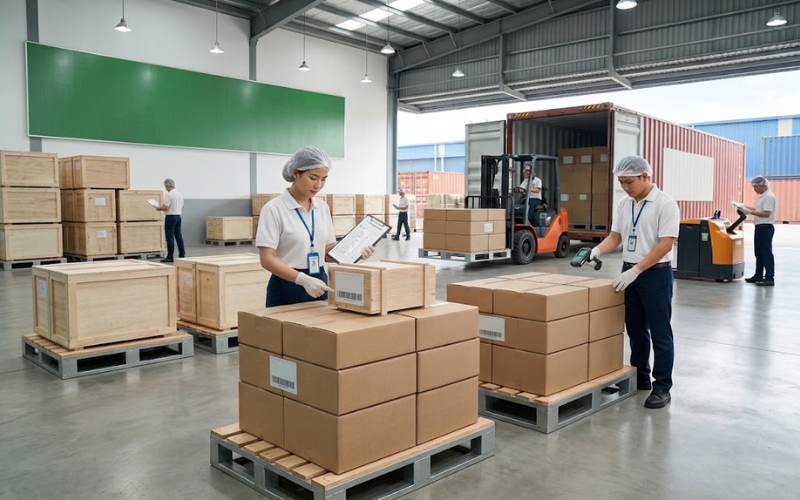
Transparent terms defend importers against contractual exposure. Industrial Vietnamese processors set Minimum Order Quantities (MOQ) at one 20ft dry container (approximately 8 to 10 metric tons of bulk bagged leaf) or one 40ft High Cube container (20 to 22 metric tons). Specialized OEM flavored lines or wild Shan Tuyet teas allow smaller trial MOQs ranging from 500 kg to 2 metric tons.
For initial commercial transactions, an Irrevocable Letter of Credit payable at sight (100% L/C at sight) or structured Telegraphic Transfer (30% advanced deposit, 70% against clean onboard ocean Bill of Lading and primary shipping documents) secures the transaction for both parties.
Because dry tea leaf is highly hygroscopic and absorbs surrounding odors instantly, transoceanic cargo packing requires strict specifications:
- Primary Packaging: Heavy-duty 3 to 4 ply reinforced Kraft paper sacks with heat-sealed inner aluminum-foil (Alu-foil) liners.
- Palletizing: Export pallets heat-treated to ISPM 15 standards, secured with tight industrial PE stretch film.
- Container Environment: High-capacity calcium chloride container desiccant bags mounted inside to prevent ocean container sweat during rapid equatorial temperature transitions.
Compliance Standards and Export Processing Infrastructure
Historically, variations in pesticide Maximum Residue Limits (MRLs) complicated international procurement from Vietnam. Modern export-focused manufacturers have solved this challenge through farm-level controls and upgraded factory infrastructure.
Raw material regions operate under strict agrochemical oversight conforming to EU MRL regulations, US FDA guidelines, and Codex Alimentarius standards. Independent laboratories Eurofins and SGS run broad-spectrum GC-MS/MS and LC-MS/MS testing protocols on each harvest lot before issuing export clearance.
Modern packaging and processing plants maintain certifications including ISO 22000:2018, HACCP, and FSSC 22000. Importers seeking verified ethical trade can source Rainforest Alliance (RA) certified leaf, along with Halal and Kosher certified production runs. Fully automated packaging lines handle OEM and private-label production—including pyramid tea sachets and double-chamber string-and-tag teabags—directly at origin, significantly reducing landed unit packaging costs.
Black Tea Vietnam – The Strategic Origin for Global Buyers
Procuring black tea Vietnam offers an optimal balance: massive agricultural capacity, competitive FOB unit pricing, and technical processing precision that meets international manufacturing criteria. Whether you require industrial CTC tea for extraction plants, full-bodied Orthodox leaf for multi-unit beverage chains, or rare wild Shan Tuyet teas for award-winning retail packs, Vietnamese producers supply consistent commercial grades at scale. Contracting directly with established origin processors secures raw material costs and ensures long-term operational resilience. Contact Viet Global Source directly at dat.nguyen@vietglobalsource.com to request Technical Data Sheets, lot-specific COAs, and customized sample kits calibrated to your formulation requirements. Our international logistics and commodity specialists stand ready to optimize your origin sourcing program.







