
Detailed guide to exporting premium jasmine tea covering technical standards, MRLs, cold chain logistics, and foreign trade procedures to maximize FTA tariff advantages.
The global scented tea market is experiencing a profound shift in consumer taste. Buyers in North America, Europe, and East Asia no longer settle for industrial, chemically scented teas. Instead, they seek sensory depth from premium tea buds infused with fresh, natural blossoms. Amid sharp volatility across Asian supply chains, thoroughly evaluating processing capacity, laboratory inspection barriers, and logistics solutions allows international importers to optimize their product portfolios. Within this shifting environment, jasmine tea Vietnam emerges as a strategic bright spot, delivering high intrinsic quality and strong economic efficiency for global purchasers.
Evaluating the Competitiveness of Jasmine Tea Vietnam in the High-End Global Segment
Traditional brands from Mainland China and Taiwan have long dominated the premium scented tea segment. However, rising operational costs and shifting climate patterns open commercial space for Southeast Asian supply sources.
Quality Comparison with High-Grade Jasmine Teas from Fujian and Taiwan
On the commercial scale, the sensory profile of jasmine tea Vietnam maintains a distinct character shaped by unique terroir. Most Fujian jasmine teas use local small-leaf green tea varieties (Camellia sinensis var. sinensis) from low-altitude hills, producing a delicate aroma that yields a thin liquor and fades quickly after 3 to 4 infusions. In contrast, Vietnam's premium tier utilizes ancient Shan Tuyet tea (Camellia sinensis var. assamica) harvested from the Tay Con Linh range (Ha Giang) at elevations above 1,500 meters, or tender shrimp buds from Tan Cuong (Thai Nguyen). This thick tea base contains high natural levels of theanine and catechins, preserving a full body and a lingering, deep sweetness through multiple scenting cycles.
Regarding fresh flower supplies, Hengzhou County (Guangxi, China) supplies over 80% of China's jasmine harvest, where fresh flower procurement costs surge to 30–38 RMB/kg during peak seasons (Source: China Tea Marketing Association - CTMA). Meanwhile, specialized Vietnamese cultivation hubs in Tay Ninh, Nam Dinh, and Hanoi benefit from ideal tropical conditions, allowing steady flower harvests from April through October. This abundance of organic fresh blossoms allows Vietnamese artisan workshops to run multi-cycle scenting rounds using high flower-to-tea ratios while keeping ex-factory prices competitive.
Supply Chain Advantages and Tariff Preferences Under New-Generation FTAs
New-generation free trade agreements signed by Vietnam, most notably the EVFTA (EU-Vietnam Free Trade Agreement) and CPTPP (Comprehensive and Progressive Agreement for Trans-Pacific Partnership), provide strong trade leverage.
Under EVFTA tariff commitments, import duties on scented green teas from Vietnam into the 27 European Union member states dropped immediately to 0% upon entry into force or follow an accelerated elimination schedule (Source: Free Trade Agreement Portal - Ministry of Industry and Trade of Vietnam). In contrast, equivalent Chinese tea products entering the EU face MFN tariffs ranging from 3.2% to 12.5% depending on retail packaging formats. In the United States, elevated tariff burdens on traditional sourcing regions create a 7% to 15% net profit margin advantage for buyers choosing Vietnamese supplies.
Manual production labor costs across Vietnamese tea artisan regions remain 30% to 45% lower than those in key tea centers across Taiwan or Fujian, providing a pricing edge in the high-grade commercial category (Source: Survey of Agricultural Production Costs in Asia - Japan External Trade Organization, JETRO).
Global Specialty Tea Positioning and Market Expansion Potential
The global specialty tea and organic herbal tea sector maintains a 6.8% compound annual growth rate (CAGR) from 2021 to 2028, heading toward an overall market value above 35 billion USD (Source: Global Tea Market Report - Grand View Research). Consumers in discerning markets like Germany, France, the United States, and Japan increasingly reject artificial flavoring substances and demand verifiable geographical indications.
Capitalizing on this momentum, Vietnamese exporters are moving away from unbranded bulk shipments toward value-added, internationally certified finished products and premium OEM/Private Label lines. Combining custom flavor profiles tailored to Western palates with heritage terroir narratives provides strong commercial leverage for global distributors expanding their high-end retail presence.
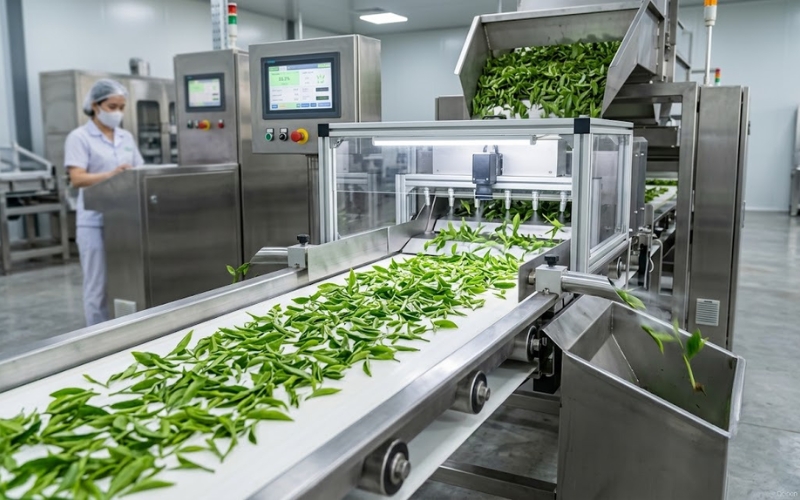
Classification System and Quality Standards for Premium Scented Tea
To classify naturally scented teas accurately in cross-border trade, tea cuppers and international procurement specialists rely on strict technical standards across three main pillars.
Demanding Requirements for Base Tea Grades
The base tea determines more than 60% of the finished product's quality. High-end production completely excludes coarse leaves, mature foliage, fibrous stalks, and tea fannings:
- Plucking Standards: Exclusively use young shoots harvested according to "single bud" (needle tips covered in fine down) or "one bud, one tender leaf" plucking standards, hand-picked early in the morning right after the mist clears.
- Heat Processing: Precise temperature management during pan-firing or steaming locks in the natural chlorophyllic yellow-green hue, preventing scorch marks along the leaf edges.
- Dry Leaf Appearance: Finished dry leaves show tight twists, uniform downy white tips, consistent sizing, and mechanical broken dust content strictly below 1%. Dry leaf tastings reveal a gentle, clean astringency without throat scratch, immediately yielding a crisp sweetness.
Natural Multi-Cycle Infusion with Fresh Sambac Jasmine
Traditional scenting methods blend botanical biochemistry with master artisan technique. Producers select single-petal Jasminum sambac flowers, which feature thick petals and essential oil concentrations far exceeding double-petal varieties:
- Harvesting Schedule: Workers pick buds strictly between 14:00 and 17:00 when they are packed with nutrients and reach the early blossom stage. Workers spread the buds evenly on clean floors to cool down and equalize internal temperatures.
- Scenting Window: Between 21:00 and 23:00, when petals crack open and emit their strongest fragrance, workers blend the flowers with dry tea leaves using specific formulas, typically 800g to 1kg of fresh blossoms per 1kg of dry tea base.
- Multi-Tier Scenting and Drying: Producing super-premium jasmine tea Vietnam requires 4 to 7 distinct scenting rounds. Each cycle lasts 18 to 24 hours to let the tea absorb volatile essential oils. Workers then sift out the spent flowers completely before slow-baking the leaves to reduce moisture before the next fresh floral batch. The entire method excludes synthetic aromatic oils.
Super Premium Sensory Profile
Sensory evaluation follows standardized international cupping procedures (ISO 3103):
- Liquor Color: The infusion runs clear without particulate haze, showing a luminous honey-yellow or amber-gold hue.
- Aroma Complexity: Natural jasmine notes release cleanly and integrate deeply into the tea leaf core, avoiding the fleeting, disconnected aroma typical of sprayed oils. The scent lingers steadily even after the cup cools down.
- Steeping Endurance: High-grade leaves sustain fragrant notes and deep back-palate sweetness across 5 to 7 consecutive infusions. Spent tea leaves unfurl fully, preserving tender, soft, and meaty bud structures.
International Technical Specifications and Laboratory Testing for Jasmine Tea Vietnam
Passing tests at independent accredited laboratories is mandatory for smooth customs clearance into developed markets. Meeting these technical regulations validates the consistency and safety controls of jasmine tea Vietnam supply chains.
Maximum Residue Limits (MRLs) by Destination Market
Pesticide residue management represents a major hurdle in agricultural exports. For premium scented tea, chemical risks stem from both the raw green leaf and the fresh floral inclusions. Farms must apply rigorous Integrated Pest Management (IPM) systems across cultivation sites:
- European Union (EC Regulation 396/2005): The EU maintains world-leading, stringent MRL rules. Common compounds like Acetamiprid, Dinotefuran, Imidacloprid, Thiamethoxam, and Chlorpyrifos are held to the Limit of Quantification (LOD), typically 0.01 mg/kg or 0.05 mg/kg. Shipments of jasmine tea Vietnam bound for the EU require validated lab reports issued by testing agencies like Eurofins, SGS, or TÜV SÜD.
- United States (US FDA): Tea imports undergo inspection under US Environmental Protection Agency (EPA) tolerances. Lots cannot contain unapproved residues that lack established safety tolerances for tea.
- Japan (Positive List System): Japan enforces a default limit of 0.01 ppm for any agricultural chemicals lacking specific tolerance entries for green tea.
Shipments must also meet heavy metal thresholds (Lead Pb ≤ 2.0–5.0 mg/kg, Cadmium Cd ≤ 1.0 mg/kg, Arsenic As ≤ 0.5 mg/kg) and mycotoxin caps (Aflatoxin B1, Total Aflatoxins B1+B2+G1+G2 ≤ 4–10 mcg/kg, Ochratoxin A).
Physical-Chemical Parameters for Premium Batches
Fresh flowers carry high moisture levels (up to 80%–85%). Substandard drying between scenting cycles causes moisture reversion, risking mold growth and the thermal degradation of volatile aromatic esters:
- Moisture Content: Finished tea leaving the factory must register within the strict ≤ 6.5%–7.5% range. This physical threshold halts endogenous enzymatic reactions and prevents microbial proliferation.
- Ash Content: Total ash must not exceed 7.0%–8.0%, while acid-insoluble ash must remain below 0.5%–1.0%, proving that raw ingredients underwent rigorous screening to remove inorganic dust and grit.
- Water Extract: Must register at 32%–36% minimum, ensuring a rich mouthfeel when brewed.
Mandatory Quality Certifications and Commercial Value-Add
To secure placement with supermarket chains and international specialty distributors, export-ready factories maintain multiple certifications:
|
Certification Category |
Specific Standards |
Scope & Commercial Value for Importers |
|
Baseline Food Safety |
Verifies physical, chemical, and biological hazard controls across processing lines. |
|
|
Global Retail Benchmarks |
FSSC 22000 / BRCGS |
Fulfills mandatory vendor requirements for Tier-1 retailers across the EU and North America (Costco, Walmart, Carrefour). |
|
Certified Organic |
USDA Organic, EU Organic, JAS |
Validates products as 100% free from synthetic fertilizers, synthetic pesticides, and GMOs from farm to pack. |
|
Social Responsibility & Sustainability |
Rainforest Alliance, Fairtrade |
Strengthens ethical branding, safeguards farm labor rights, and supports ecosystem biodiversity. |
Holding these certifications reduces factory audit times and gives importers confidence when developing scalable, sustainable product lines.

Preservation Logistics and International Trade Procedures for Jasmine Tea Vietnam
A common mistake in agricultural transport is focusing only on factory-gate specs while ignoring in-transit vulnerabilities. Scented tea leaves are porous, hygroscopic, and quick to absorb ambient odors. Maintaining quality throughout the movement of jasmine tea Vietnam requires dedicated export packaging and transport controls.
Packaging Configurations for Aroma Retention
Export packaging functions as an active barrier against environmental degradation:
- Primary Packaging: Multi-layer aluminum foil laminate barrier pouches (PET/AL/PE or PA/AL/PE) with a thickness of 120–150 microns provide a complete barrier against UV light, moisture vapor, and oxygen penetration (oxygen transmission rate near zero). Before heat-sealing, packers deploy vacuum sealing or inert nitrogen (N2) flushing to prevent lipid oxidation and protect delicate fragrance esters.
- Secondary Packaging: Sealed foil pouches pack into 5-ply or 7-ply heavy-duty corrugated cartons (AB or BC flute) constructed from high-grammage linerboard with a water-resistant outer finish. The cartons withstand high compression loads during multi-tier container stacking.
- Pallet Stability: Cartons sit on heat-treated, ISPM 15-stamped wooden pallets to avoid clearance rejection at arrival ports. Crews wrap pallets in multi-layer stretch film and reinforce corners with heavy-duty cardboard edge protectors to prevent shifting during cargo handling.
Sea and Air Freight Supply Chain Controls
Each transport mode demands specific safeguards to maintain cargo value for jasmine tea Vietnam:
Export Transport Control Steps:
- Step 1 (Production Facility): Vacuum-pack in multi-layer aluminum foil to block moisture and ambient light.
- Step 2 (Container Inspection & Preparation): Air out residue odors; confirm wooden floors are clean and show moisture levels below 12%.
- Step 3 (Stuffing & Desiccant Placement): Secure pallets firmly; hang 16 to 32 bags of calcium chloride (CaCl2) desiccants along internal container walls.
- Step 4 (Ocean Transit): Instruct ocean carriers to stow dry containers below deck (Under Deck) to shield cargo from direct solar radiation.
- Step 5 (Destination Port): Clear customs and transfer directly into temperature-controlled, dry warehousing.
Air Freight: Best suited for commercial testing samples, urgent F&B replenishment, or ultra-premium micro-lots valued at several hundred dollars per kilogram. Transit takes 3 to 5 days, minimizing thermal and moisture degradation risks.
Ocean Freight: The preferred mode for full container loads (FCL). Dry tea shipments require standard general-purpose containers (20GP or 40GP). Never use refrigerated containers for dry tea shipments, as electrical shutdowns during handling risk interior condensation.
Customs Clearance and Trade Documentation
Accurate paperwork prevents costly demurrage and detention charges while eliminating inspection holds.
Harmonized System (HS) Code Classification: Trade classifications for jasmine tea Vietnam fall under HS Heading 0902:
- Code 0902.10: Green tea (not fermented) in immediate packings of a content not exceeding 3 kg.
- Code 0902.20: Other green tea (not fermented) in packings exceeding 3 kg (bulk export sacks).
Standard Trade Documentation Package:
|
Document Name |
Purpose & Contents |
|
Commercial Invoice |
Specifies unit pricing, contracted Incoterms (FOB, CIF, CFR, DDP), and payment terms. |
|
Packing List |
Details carton tallies, package types, Net Weight, Gross Weight, and cubic volume (CBM). |
|
Bill of Lading (B/L) / Airway Bill (AWB) |
Acts as cargo receipt and title document; issued as Original B/L, Surrendered B/L, or Seaway Bill per contract terms. |
|
Phytosanitary Certificate |
Issued by the Plant Protection Department of Vietnam, certifying the lot is free from quarantine pests and plant diseases. |
|
Health Certificate (HC) |
Confirms manufacturing occurred in a food-safe facility and the tea is fit for human consumption. |
|
Certificate of Analysis (CoA) |
Independent laboratory report confirming physical-chemical metrics, micro-counts, heavy metals, and MRL compliance under ISO/IEC 17025. |
|
Certificate of Origin (C/O) |
Secures preferential import tariffs: Form EUR.1 (EU via EVFTA), Form CPTPP (Canada, Japan, Australia), Form E (ASEAN-China), or standard Form B. |
B2B Commercial Supply Policies
Long-term stability and supply consistency form the foundation of international B2B relationships:
- Flexible MOQs: Reputable processors offer tailored Minimum Order Quantities (MOQs): 100–300kg for specialized bulk shipments or initial market test orders, and 500–1,000kg for private label OEM/ODM packing.
- Retention Samples and PSS Verification: Exporters keep dual retention samples in climate-controlled libraries for 12 to 24 months. Prior to mass dispatch, processors supply an exact Pre-Shipment Sample (PSS) pulled from the finished run for buyer cupping and lab verification, guaranteeing commercial shipments match approved lots.
Sourcing Jasmine Tea Vietnam: A Strategic Choice for Global Buyers
High-end jasmine tea Vietnam commands attention in international specialty beverage markets by pairing heritage Shan Tuyet base teas with natural multi-cycle flower scenting techniques. Sourcing from Vietnam cuts procurement tariffs through active free trade pacts (EVFTA, CPTPP) while delivering strict compliance with international MRL standards, organic verification, and aroma-preserving shipping methods. To request factory audit reports, product specification sheets, or a tasting sample kit, contact the international commercial desk at Viet Global Source: dat.nguyen@vietglobalsource.com.







