
Certified international supply solutions for premium black tea Vietnam. Ensure flavor consistency and high volume for beverage chains with Viet Global Source.
The historic gold medal win for high-mountain tea buds at the prestigious AVPA Paris competition marked a new era for tea exports. Vietnam has broken free from its reputation as a supplier of low-cost raw ingredients. The debut of this specialty black tea Vietnam selection in the world culinary capital establishes direct competition against traditional producers like Sri Lanka and India. Evaluated through rigorous blind tastings by a panel of European sensory experts, this tea made an immediate impression with its luminous amber-red liquor, heavy body, and complex aromatic layers spanning wild forest honey, ripe fruit, and gentle malt.
For international procurement heads and food and beverage R&D managers, spotting superior cup quality represents only the opening move. The survival challenge centers on process standardization and dependable commercialization. Turning an award-winning micro-lot into a scalable commercial supply line—shipping tens of containers annually without diluting baseline cup attributes—demands a clear operational strategy. This execution decides which beverage chains win market share.
The International Gold Award and Commercial Scaling for Premium Black Tea Vietnam
Securing gold at AVPA Paris placed Vietnamese ancient Shan Tuyet tea buds directly into the international catalog of high-end agricultural commodities. This victory instantly caught the attention of multinational drink groups and five-star hospitality operations. Yet beyond the award stage, the enterprise must confront deep systemic hurdles in domestic processing.
The Gap Between Handcrafted Micro-Lots and Commercial Scale
The teas winning gold at AVPA Paris stem almost exclusively from micro-lots. Local artisans craft these batches by hand, yielding only dozens or a few hundred kilograms. In contrast, large beverage brands and modern tea franchises need a steady B2B supply of black tea Vietnam scaling to dozens of metric tons monthly to support footprint networks spanning hundreds of stores.
This wide gulf between artisanal craft and industrial mass output represents the primary operational barrier. When scaling volume without automated process monitoring, the attributes that won over French judges—subtle honey notes and delicate astringency—rapidly degenerate into harsh, astringent bitterness. Locating an industrial facility that accurately reproduces award-winning profiles at scale remains an urgent industry challenge.
Managing Crop-to-Crop Consistency Barriers
As a specialty crop tied closely to microclimates, the final cup grade of black tea Vietnam reacts quickly to seasonal weather changes. Spring-picked buds hold abundant amino acids, yielding airy floral aromas and clean sweetness. Summer and autumn harvests build up higher tannin levels; these yield deep-colored infusions that turn unpleasantly bitter without precise leaf handling.
Profile swings across seasons disrupt commercial operations. Mixologists cannot rewrite standard operating procedures or bar syrup ratios every month just because an incoming lot pulls a heavier extraction. Without automated thermal control, managed humidity, and forced-air handling, lot-to-lot consistency turns into an operational hazard for corporate buyers.
The Lack of Transparent Technical Baselines
Domestic markets have historically relied on the subjective palates of tea masters to verify quality. Omitting detailed Technical Data Sheets causes friction, misunderstandings, and commercial disputes in global logistics.
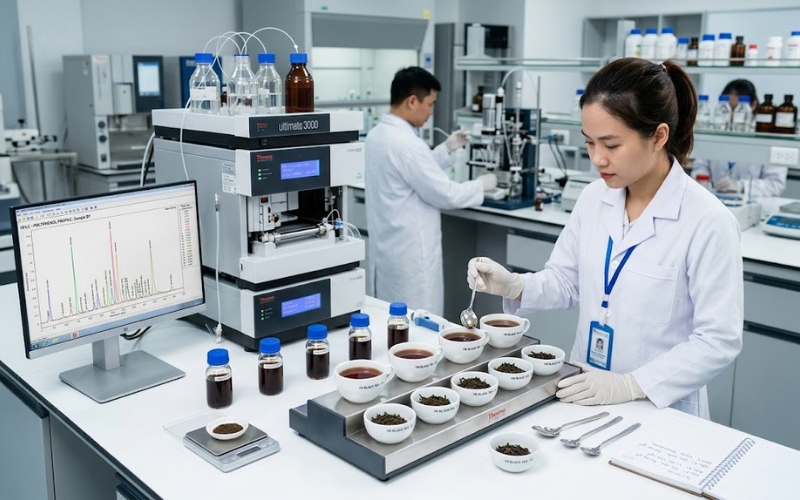
Overseas buyers demand defined physical and chemical baselines: verified moisture content, precise particle mesh size, total ash parameters, golden tip ratios, and verified maximum residue limits (MRLs) for agricultural chemicals. Lacking calibrated laboratory analysis, pricing and marketing specialty leaves internationally inevitably triggers regulatory bottlenecks and costly inspection failures.
Commercial Risks of Inconsistent Specialty Black Tea Vietnam Raw Materials
Ignoring quality verification at the farm-gate level triggers severe financial losses that damage brand equity across competitive hospitality sectors.
Degradation of Signature Drink Profiles
Signature drink menus sustain premium price points through reliable sensory performance. High-altitude black tea Vietnam presents fragile natural compounds reminiscent of natural bergamot, cane molasses, and dried tropical stone fruits.
When facilities blend inferior filler leaves or overheat batches during drying, these delicate aromatics vanish. Customers receive a flat, bitter drink that destroys the profile of a flagship recipe. The degraded experience damages patron retention and drives foot traffic away.
Unbalanced Extractions in High-End Formulations
Formulating balanced bases presents a constant challenge for beverage development teams. In recipes such as cheese-foam milk teas, cold brews, or fresh fruit blends, the tea base must provide a firm body to anchor fatty dairy solids or sharp fruit acidity.
If the black tea Vietnam raw material lacks target soluble solids and uniform extraction yield, the bar suffers severe drink separation. The base turns watery over ice or develops cloudy tea-cream sedimentation that ruins drink presentation. To patch these defects, chains turn to synthetic flavoring syrups, discarding clean-label commitments.
Operational Bottlenecks During Retail Expansion
When a drink brand rolls out franchise units or enters international territories, procurement systems face immense strain. Relying on fragmented cottage processors without verified capacity puts operations on edge.
A sudden cold snap in the growing zone or packing line delays leave multi-unit stores out of core ingredients. This break cuts daily store revenues, stalls multi-million-dollar marketing pushes, and opens room for competitors to capture foot traffic.
Quality Benchmarks Defining Specialty Black Tea Vietnam
Differentiating commercial grade tea from specialty grade relies on strict technical metrics covering geography, soil science, and biochemistry.
High-Altitude Terroir Above 1,200 Meters
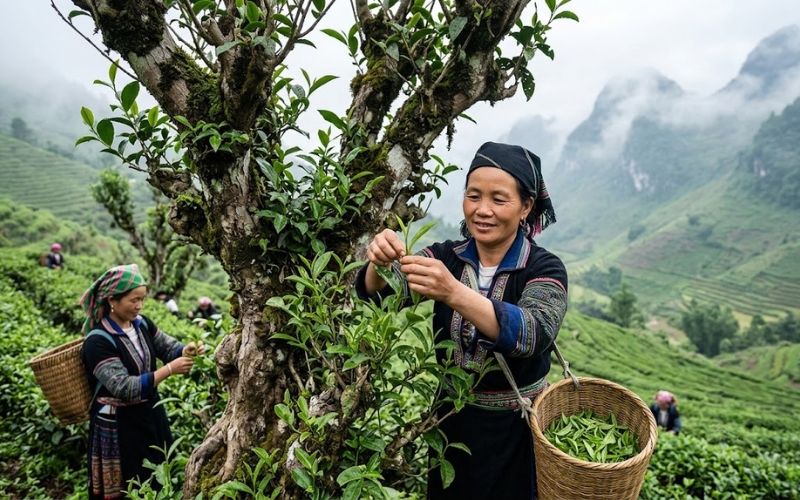
Producing premium black tea Vietnam requires high elevations, such as the northern mountains of Ha Giang and Yen Bai or the volcanic plateaus of Lam Dong. At elevations exceeding 1,200 meters, broad diurnal temperature swings and persistent cloud cover slow down photosynthesis. This biological pace concentrates polyphenols and free amino acids at rates well above low-altitude plantings.
Field protocols require manual hand-plucking: one bud with one leaf, or at most one bud with two tender leaves. Silvery down covers these tender shoots, indicating concentrated essential oils. Pickers place freshly plucked green leaves into breathable bamboo baskets and transport them swiftly to avoid mechanical bruising, preventing premature oxidation before formal processing.
Optimized Ratios of Theaflavins and Thearubigins
Specialty processing quality depends on measurable laboratory parameters. Managed oxidation transforms raw catechins into two critical groups of color and flavor compounds: theaflavins (TF) and thearubigins (TR).
- Theaflavins: Provide liquor clarity, brilliant amber-orange highlights, and brisk energy on the tongue.
- Thearubigins: Deliver warm reddish-brown depth, viscous mouthfeel, balanced body, and persistent throat sweetness lasting long after the sip.
Balancing these two compound groups alongside moderate natural caffeine prevents black tea Vietnam from developing bitter extraction defects at higher brewing temperatures, protecting flavor balance during service.
Strict Export Compliance and Safety Certifications
Sensory appeal must be backed by food safety and purity records. Penetrating monitored retail circuits across Europe, North America, and Japan requires passing independent laboratory testing through firms like SGS or Eurofins.
Mandatory compliance criteria:
- Zero detectable heavy metal traces (Lead, Cadmium, Arsenic).
- Zero contamination from pathogenic microorganisms and mycotoxins.
- Clean pesticide screening panels meeting European Union MRL mandates.
- Processing operations certified under ISO 22000, HACCP, alongside sustainability systems such as Rainforest Alliance or USDA/EU Organic.
Supply Chain Standardization and Processing Black Tea Vietnam
To transform plantation resources into international market advantages, modern operations invest in high-throughput automation and specialized contract processing.
Automated Microclimate Oxidation Management
Processing top-tier black tea Vietnam requires precise climate control inside the fermentation room. Rather than leaving batches exposed to shifting ambient weather, digital environmental controls hold exact setpoints: temperatures steady between 22 and 24 degrees Celsius, relative humidity at 90 to 95 percent, and continuous forced-air oxygenation.
Controlling the oxidation curve ensures uniform enzyme activity from the leaf core out through the epidermis. Raw grassy notes break down into complex, sweet fruit aromatics. Automated fluid-bed drying drops final moisture below 5 percent, locking down aromatics and preventing moisture absorption during container ocean transit.
Custom Leaf Grading for Target Extraction Methods
Beverage applications demand tailored extraction mechanics. A commercial OEM provider offers versatile particle classifications matching distinct formulation goals:
|
Leaf Grade |
Technical Characteristics |
F&B Application |
|
Whole Leaf (OP, Tippy Golden) |
Whole, tightly rolled tea shoots covered in downy white hair. |
Full-leaf pot service in fine dining, boutique hotels, and specialty cold infusions. |
|
Broken Leaf (FBOP, BOP) |
Mechanically cut uniform particles offering expanded surface exposure for rapid color yield and rich body in 3 to 5 minutes. |
Milk tea concentrates, chai formulations, and cheese-foam bases. |
|
Fine Milling (Fannings / Premium Dust) |
Finely ground particles milled directly from premium high-mountain bud lots. |
Ready-to-Drink (RTD) bottle extraction, canned beverages, and commercial pyramid tea sachets. |
Calibrating particle sizes optimizes raw ingredient costs per pour and streamlines bar preparation times across fast-paced counters.
Preservation Packaging for Global Ocean Freight
Export logistics must protect raw teas against environmental decay—light exposure, ambient oxygen, thermal stress, and ocean humidity during long sea voyages.
Industrial container freight runs inside multi-wall kraft bags lined with thick aluminum-barrier laminates. Pack lines vacuum-seal each unit or inject protective food-grade nitrogen before heat-sealing. This oxygen-barrier barrier stops vapor transmission completely, ensuring that our black tea Vietnam arrives in ports like Rotterdam, New York, or Tokyo with factory-fresh aromatics intact.
Partner with a Trusted Manufacturer of Black Tea Vietnam to Build Your Brand
Combining distinct mountain terroir with clean processing technology turns black tea Vietnam into a dependable driver of beverage brand growth. Partnering with a standardized source resolves consistency issues, protects operating margins, and secures premium recipe execution. Request your Master Sample Kit along with detailed Certificate of Analysis (COA) documentation for your project by writing directly to Viet Global Source at dat.nguyen@vietglobalsource.com.







