Technical guide to grading jasmine tea Vietnam for export. Analyze base tea leaves, fresh flower scenting cycles, and global supply chain QA/QC protocols.
In the beverage processing and agricultural export sectors, rigorous quality control from plantation to finished goods dictates brand viability. Benefiting from exceptional terroir and indigenous single-petal jasmine varieties, jasmine tea Vietnam secures an increasingly prominent position in the global ingredient supply chain. Faced with stringent requirements regarding food safety limits, pesticide residues, and batch-to-batch consistency, international importers and procurement specialists require a clear standard framework to evaluate each product tier accurately. This guide delivers a comprehensive breakdown of quality grades, fresh flower scenting cycles, and specialized sensory cupping protocols, helping commercial buyers identify optimal supply sources that reduce procurement costs and maximize trade value.
Market Overview and the Strategic Value of Jasmine Tea Vietnam in Global Supply Chains
Natural flower-scented tea represents one of the fastest-growing categories in the international commercial beverage sector. Within this category, jasmine tea Vietnam occupies a strategic position through its synergy of expansive green tea growing zones and a tropical climate ideally suited for single-petal jasmine blossoms (Jasminum sambac). For multinational F&B corporations, ingredient importers, and global beverage chains, mastering the grading structure of this product serves as a vital prerequisite for optimizing purchasing budgets and standardizing recipe output.
Export Standing and Global Commercial Potential
Vietnam's tea sector has long ranked among the world's leading volume exporters. Transitioning toward value-added, deep-processed products creates the industry's real commercial momentum. Sourcing programs for jasmine tea Vietnam maintain a strong market footprint across demanding destinations such as Taiwan, the United States, the Middle East, and the European Union (EU), driven by the surging demand for premium milk teas and ready-to-drink (RTD) formulations.
Unlike double-petal varieties whose high moisture content risks sour, stale notes, indigenous Vietnamese single-petal jasmine yields an essential oil rich in benzyl acetate and linalool. This composition delivers a pure, deep, long-lasting floral profile. When blended with green tea bases sourced from northern midland plantations or the Southern Central Highlands, the resulting product yields a distinct sensory signature that satisfies modern mixology and commercial beverage formulation requirements. The commercial value of jasmine tea Vietnam transcends commodity trading, positioning it as an essential building block shaping global beverage profiles.
Technical Compliance Challenges Across Agricultural Supply Chains
Realizing this potential requires clearing strict international regulatory barriers. Food safety authorities in developed target markets enforce stringent Maximum Residue Limits (MRLs) for agricultural chemicals. Any commercial shipment of jasmine tea Vietnam faces border rejection if laboratory testing uncovers unauthorized active substances or residue levels exceeding European Commission (EC) Regulation No 396/2005.
Microbiological compliance poses an equally critical challenge. Traditional scenting with fresh blossoms introduces natural moisture and ambient microorganisms into the dry tea leaf matrix. Without rigorous process control during air dissipation, petal separation, and final heat drying according to HACCP and ISO 22000 standards, shipments face high risks of Salmonella, mold spores, or out-of-spec Coliform counts. Cheap products flavored with artificial aromatics distort commercial benchmarks, forcing institutional buyers to implement rigorous chemical analysis to verify authentic botanical scenting.
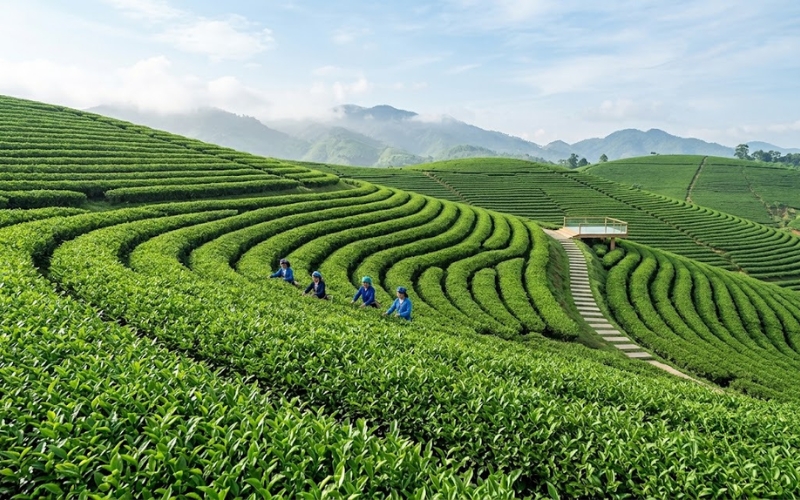
Base Tea Quality Standards: The Quality Foundation of Jasmine Tea Vietnam
Raw base tea accounts for 60% of the overall quality profile in any finished batch. Even the purest floral scenting cannot mask defective, under-aged base leaves, improper thermal processing, or coarse, woody stems. Systemic grading of raw base tea serves as an indispensable first gate in quality management.
Visual Appearance Grading: Specialty Buds to Industrial Cuts
- Base tea intended for the manufacturing of jasmine tea Vietnam undergoes clear visual stratification based on plucking standards and leaf integrity following pan-firing (enzyme deactivation), rolling, and primary drying:
- Specialty Grade Base (Single Bud, 1 Bud 1 Leaf, 1 Bud 2 Leaves): Premium pluckings harvested primarily from midland Thai Nguyen terroirs or ancient Shan Snow trees in Ha Giang. The dry leaf features tight twists coated with dense silver down (trichomes), rich in free amino acids that provide a velvety texture and an enduring sweet finish.
- Commercial Grade Base (OP, Pekoe): Medium-sized leaf profiles harvested under a 1 bud with 2 to 3 mature leaves standard. Leaves feature uniform twisting and balanced astringency, constructing a solid structural body that readily absorbs floral volatile oils without suppressing natural aromatic top notes.
- Industrial Grade Base (BPS, Broken, Fannings): Small broken fractions and siftings derived from mechanical classification lines. Despite an uneven visual appearance, these grades provide extensive surface area for accelerated soluble extraction, presenting a cost-efficient ingredient for high-capacity industrial extraction plants and mass-market tea bag packers.
Export-ready jasmine tea Vietnam requires high physical particle uniformity achieved via calibrated mesh sizing screens, stripping out dust, fannings, and foreign material before batching with fresh floral blossoms.
Physicochemical Metrics Governing Natural Scent Absorption
A base leaf's absorption capacity depends directly on inherent physicochemical metrics. Processing plants must control two primary parameters before scenting runs:
First, moisture content (W). Prior to scenting, raw leaf moisture must stay within 4.5% to 6.0%. Initial moisture above 7.5% saturates the leaf cellular pores, blocking vaporized jasmine essential oils from penetrating deep tissue layers. Over-drying from excessive thermal processing collapses capillary pathways, preventing lasting retention of aromatic compounds.
Second, total Polyphenols and Catechins. A base displaying polyphenol concentrations between 18% and 25% provides structural briskness that anchors organic volatile scent molecules. The chemical equilibrium between L-theanine (savory sweetness) and total catechins (astringency) governs the mouthfeel balance of finished jasmine tea Vietnam.
Export Grades of Jasmine Tea Vietnam Based on Fresh Flower Scenting Cycles
The commercial grade of the final product depends directly on scenting technology and processing duration. Based on the number of fresh scenting cycles and the ratio of fresh blossoms to dry base leaf, processors sort finished lots into distinct technical grades.
Technical Stratification: Scenting Cycles and Blossom-to-Tea Ratios
Fresh flower scenting demands precise operational control. Processors classify product output into four technical tiers based on scenting cycles:
- Grade 1 (Super Premium - Imperial Selection): Crafted using top-tier tippy buds, passing through 4 to 5 consecutive fresh flower scenting cycles. The aggregate flower-to-tea weight ratio reaches approximately 1:1 (consuming 1.0 to 1.2 kg of fresh flowers per 1.0 kg of dry tea). Each cycle runs for 18 to 24 hours, followed by mechanical sifting to eliminate spent petals and gentle drying before starting the next blossom load. The liquor yields a luminous honey-golden hue, complex multi-layered floral notes, no harshness, and enduring sweetness across 6 to 8 successive infusions.
- Grade 2 (Premium Foodservice): The workhorse ingredient engineered for high-end milk tea concepts and major commercial beverage chains. Formulated on OP or Pekoe base grades, it undergoes 2 to 3 scenting cycles at a ratio of 0.6 to 0.8 kg of fresh flowers per kg of dry base. This level of jasmine tea Vietnam achieves exceptional balance: a brisk green tea backbone that stands up to dairy and fruit syrups while releasing an assertive natural floral scent.
- Grade 3 (Commercial Grade): Processed through 1 to 2 fresh scenting cycles using an input ratio of 0.3 to 0.4 kg per kg of dry leaf. This cost-effective profile suits wholesale distributors and value-oriented beverage operators requiring stable year-round volume.
- Standard Grade (Flavored / Scent Boosted): Combines a single foundational fresh flower scenting run with food-grade natural botanical extracts sprayed during final processing. This tier delivers sharp price competitiveness for cost-sensitive import accounts, provided that all added extracts feature verified origin certificates and meet destination market food additive regulations.
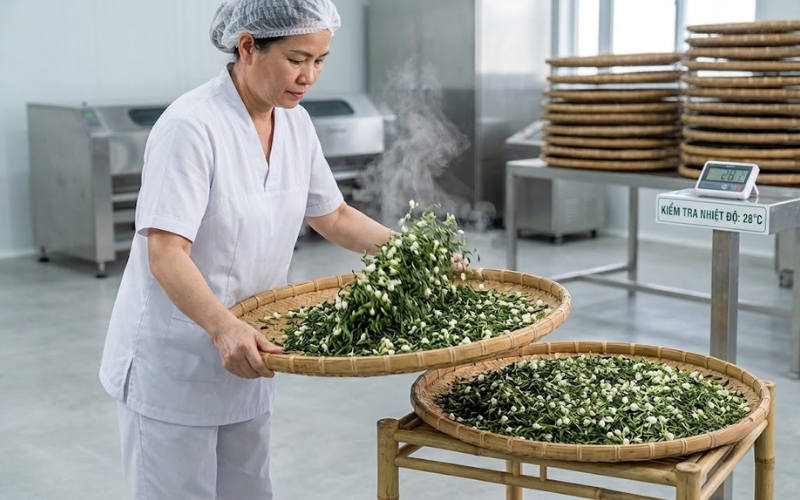
Critical QA/QC Protocols: Pile Aeration and Final Moisture Lock
During the scenting phase, live jasmine blossoms continue cellular respiration, generating exothermic heat and water vapor. Piles experience rapid temperature spikes. Within 5 to 7 hours of blending, internal pile temperatures can climb past 45°C. Without prompt heap turning—thinning out the piles to disperse internal heat and supply oxygen for continued blooming—the trapped thermal energy scorches delicate petals and triggers anaerobic fermentation. This defect turns jasmine tea Vietnam sour, dulls the liquor into a cloudy reddish-brown, and creates unpleasant fermented odors.
Process parameters mandate maintaining internal pile temperatures below 40°C throughout every cycle. Once machinery separates out all spent petals, the final drying stage establishes commercial shelf stability. Processors apply indirect hot air at 85°C to 90°C to bring final product moisture below or equal to 6.5% (W ≤ 6.5%). This strict parameter halts mold formation during long ocean freight transits and locks volatile floral compounds firmly inside jasmine tea Vietnam leaf structures.
Procurement Guide: Selecting and Evaluating the Right Jasmine Tea Vietnam Grades
For procurement specialists, evaluating supplier samples prior to executing sales contracts requires empirical laboratory protocols rather than subjective tasting notes. Selecting an improper grade inflates operating costs or causes formulation inconsistencies across target consumer markets.
Sensory Cupping Protocol: Natural Blossoms vs. Synthetic Flavoring
Formal sensory evaluation follows the ISO 3103 protocol. Weigh an exact 3.0 g sample of jasmine tea Vietnam, pour 150 ml of boiling water at 95°C, and infuse for exactly 5 minutes in a covered porcelain cupping set.
Use these empirical markers to distinguish between natural botanical scenting and artificial chemical flavoring:
|
Evaluation Parameter |
Natural Fresh Blossom Scenting |
Artificial Chemical Flavoring |
|
Dry Leaf Aroma |
Subtle, soft floral notes supported by a clean herbal undertone. |
Sharp, pungent chemical punch; often displays soapy or solvent-like undertones. |
|
Infusion Longevity |
Smooth, steady floral release expanding from the 2nd through 5th steep, coating the palate. |
Overpowering top notes on the 1st steep that decline steeply by the 2nd, leaving a flat, astringent base by steep 3. |
|
Liquor Appearance |
Clear bright golden-yellow with delicate green reflections, free of suspended sediment. |
Cloudy, dull liquor; frequently exhibits a greasy film of volatile oil floating on the surface. |
|
Mouthfeel & Finish |
Crisp, clean astringency clearing the palate, followed by an authentic sweet aftertaste. |
Harsh, drying bitterness leaving an artificial chemical coating in the throat. |
Thorough cupping evaluation shields procurement teams from commercial grade inflation and substandard inventory lots.
Matching Grades to Business Models and Industrial Packaging Specs
Every processing grade serves a distinct market requirement. Commercial buyers must align procurement specifications with final distribution channels:
- Specialty Retail and Gift Collections: Specify Grade 1 exclusively. Intact leaf buds and complex botanical aromas create high shelf value and an exceptional consumer tasting experience.
- Commercial F&B Chains and Bubble Tea Brands (HoReCa): Deploy Grade 2. Its robust green tea astringency ensures that the defining floral profile of jasmine tea Vietnam cuts cleanly through fresh milk, non-dairy creamers, sweeteners, and ice without getting diluted.
- Industrial Processing (RTD Bottling and Canned Beverages): Source Grade 3 or high-surface-area broken cuts. Accelerated extraction rates reduce industrial steeping durations, lowering energy consumption and raw ingredient costs per finished liter.
Regarding transit packaging, floral essential oils degrade rapidly when exposed to ambient oxygen and light. Export packaging requires multi-layer aluminum barrier pouches of at least 100 microns thickness, vacuum-sealed or nitrogen-flushed, secured within heavy-duty 5-ply corrugated master cartons or kraft fiber drums. Maintain warehouse temperatures between 18°C and 22°C with relative humidity below 60% to prevent aromatic loss in jasmine tea Vietnam lots throughout a 24-month shelf life.
Partnering with Certified Manufacturing and Supply Chains for Jasmine Tea Vietnam
Accurate classification across raw base grades, fresh scenting cycles, and cupping parameters protects product quality and commercial viability in international distribution channels. A technical grasp of processing metrics, MRL thresholds, and microbiological safeguards empowers buyers to purchase jasmine tea Vietnam efficiently, mitigate trade risk, and deliver authentic floral flavor profiles to end consumers worldwide. Backed by supply chain expertise and compliance-focused processing operations, Viet Global Source provides scalable, transparent ingredient supply solutions. Contact our technical sales team at dat.nguyen@vietglobalsource.com to request technical data sheets (TDS), certificates of analysis (COA), and standardized evaluation sample kits across every processing grade free of charge.