Quality control standards from a wholesale black tea Vietnam supplier: TF/TR ratio optimization, FBD technology, and industrial extraction solutions for F&B plants.
In the global beverage value chain, maintaining raw material consistency directly dictates profit margins and brand equity. Ready-to-drink (RTD) manufacturers, commercial milk tea chains, and export packaging enterprises constantly battle a critical challenge: seasonal fluctuations in base tea quality, erratic extraction yields, and sensory inconsistencies. With extensive tea cultivation acreage, black tea Vietnam has emerged as a strategic supply source for international procurement teams. Procuring from an industrial-scale processing plant capable of mastering biochemical mechanics while adhering strictly to international clearance barriers requires rigorous evaluation. This article analyzes the core engineering bottlenecks in industrial processing, operational losses, and factory-direct quality standardization solutions.
Fermentation Defects in Black Tea Vietnam: Haze Risks and Flavor Degradation
The fundamental difference between green tea and black tea processing centers on enzymatic oxidation, commonly known as fermentation. When tea leaf cell walls rupture during rolling or cutting, polyphenol oxidase (PPO) and peroxidase (POD) enzymes contact atmospheric oxygen. This reaction triggers a metabolic cascade converting monomeric catechins into complex pigments and aromatic compounds. Absent precise thermo-hygrometric controls, widespread biochemical defects occur, degrading the commercial export value of black tea Vietnam.
Distorted Theaflavin to Thearubigin (TF/TR) Ratios Induce Dull Liquor and Cold Haze
Theaflavins (TF) and Thearubigins (TR) are polymerized polyphenols that determine the complete sensory profile of tea liquor. Theaflavins generate a bright orange-red hue, briskness, and clean vibrancy. Conversely, Thearubigins provide a deep reddish-brown color, mouthfeel density, and flavor depth. International commercial standards require a stable TF:TR ratio between 1:10 and 1:12.
Manual processing facilities often rely on ambient weather conditions. When ambient temperatures exceed 30°C, uncontrolled reaction rates trigger over-fermentation. Theaflavins oxidize rapidly into thearubigins and theabrownins (TB)—dark brown pigments. Consequently, the brewed tea appears murky and dull rather than brightly translucent.
For the F&B sector, elevated thearubigin levels bind with free caffeine at low temperatures to form insoluble hydrogen-bonded complexes. This precipitation creates cold brew haze (tea cream), completely destroying the visual clarity demanded in iced milk teas and bottled cold brew beverages.

Stewed and Sour Taints from Misaligned Enzymatic Deactivation
Fermentation reaches its peak when theaflavin concentration hits its maximum and aldehyde and fruit ester aroma precursors bloom fully. At this exact threshold, operators must convey the batch into the drying chamber immediately to deactivate PPO enzymes through heat. If drying capacity falls short or convective airflow fails to flash off moisture instantly, condensing water vapor penetrates back into the heat-retaining tea bed.
This trap creates a humid, anaerobic environment between 50°C and 65°C, triggering secondary microbial fermentation and anaerobic thermal degradation of organic compounds. The resulting volatile fatty acids leave the black tea Vietnam batch tainted with a stewed, overcooked vegetable odor and sour acidity. Once contaminated by this sour defect, the characteristic malty and honey flavor structure disappears completely, beyond the recovery capability of any formulation adjustments or additives.
Excessive Stalk Fiber and Dust Fines in CTC Lines
In Crush-Tear-Curl (CTC) lines feeding industrial extraction plants, physical impurity control remains vital. Counter-rotating toothed rollers shred leaf veins and young stems alongside the leaf blade. Without multi-deck vibratory sifters and dedicated electrostatic stalk separators downstream of drying, finished grades will carry fiber and fine dust fractions exceeding 15% to 20%.
Excessive dust causes uncontrolled extraction kinetics: fines dissolve instantaneously, releasing concentrated free tannins that create throat-catching astringency and harsh bitterness while eliminating the lingering sweet finish. Meanwhile, non-soluble stalk fibers expand storage volume and absorb valuable liquid extract inside commercial brewing vats without contributing soluble solids.
Operational Losses When Black Tea Vietnam Batches Fail Extraction Standards
When non-compliant raw materials enter high-throughput production lines, operational damage extends far beyond sensory flaws, converting into tangible financial balance-sheet write-downs.
Escalating Additive Expenses to Mask Color and Flavor Deficiencies
Bottled RTD beverage producers and franchised tea chains maintain rigid Standard Operating Procedures (SOPs) calibrated for batch runs spanning thousands of liters. When using inconsistent black tea Vietnam lots that deliver pale, dull liquor or off-flavors, R&D teams must implement corrective measures to rescue product runs.
Common fixes include raising synthetic flavor dosing, adding caramel colorings, and incorporating acidity regulators like citric acid or sodium citrate. These additives raise product Cost of Goods Sold (COGS) by 8% to 15% while conflicting directly with clean-label procurement mandates favored by international consumers.
Extraction Kinetic Errors Depress Dissolved Solids Yield
Industrial continuous extractors balance extraction time, water temperature, and dynamic pressure against uniform particle sizes. If a batch of black tea Vietnam carries an uncontrolled particle size distribution—mixing coarse pellets with pulverized dust—the extraction balance collapses entirely.
Fines over-extract to yield harsh bitterness, while coarse particles wet out too slowly, causing under-extraction. Consequently, Total Dissolved Solids (TDS) yields plunge, reducing operational extract recovery per kilogram of input tea leaf. Facilities burn extra thermal energy and extend machine cycle times, driving operating expenses higher.
Production Halts from Batch-to-Batch Quality Swings
Batch-to-batch variation introduces severe risk to automated filling plants. When switching from one monthly material lot to another, any drift in baseline parameters (TDS, pH, moisture content, liquor color) halts bottling lines immediately. Plant engineers and QC specialists lose hours, or entire shifts, recalibrating machinery, conducting test blends, and verifying microbiological stability.
More critically in cross-border trade, if raw lots breach Maximum Residue Limits (MRLs), contain heavy metals (lead, cadmium), or exceed microbial counts (Salmonella, molds) at destination ports, border authorities like the FDA or EFSA will detain the containers. Accumulating demurrage and detention fees, coupled with re-export or destruction expenses, can run into tens of thousands of dollars per container, permanently damaging the importer's regulatory compliance profile.
Process Standardization Solutions from a Wholesale Black Tea Vietnam Supplier
To eradicate technical defects at the source and provide industrial buyers with reliable supply safety, enterprise processors deploy automated parameter monitoring, replacing manual guesswork with data-driven operations linked to international food safety protocols.
Regulating Oxidation via Closed-Loop Industrial HVAC Systems
Stabilizing biochemical markers across commercial runs of black tea Vietnam requires housing the entire fermentation phase within climate-isolated processing chambers. The plant incorporates dedicated multi-stage HVAC systems:
- Room temperatures hold strictly within 22°C to 26°C.
- Relative humidity (RH) stays above 90% via ultrasonic humidifiers that generate micron-sized, non-condensing water vapor.
- Continuous positive-pressure clean airflow sweeps across fermentation trays and continuous fermenting units, providing uniform oxygen contact across all ruptured leaf cells.
The facility adheres strictly to ISO 22000, HACCP, and FSSC 22000 food safety management certifications, alongside Rainforest Alliance (RA) farm tracking. Independent testing laboratories such as Eurofins or SGS screen every production lot, verifying full MRL compliance against destination market regulations. This rigorous control stabilizes PPO enzyme activity and locks the TF/TR ratio within the optimal target window, delivering bright amber liquor free from cold brew sedimentation.
Locking Aroma and Stripping Moisture with Fluidized Bed Dryers (FBD)
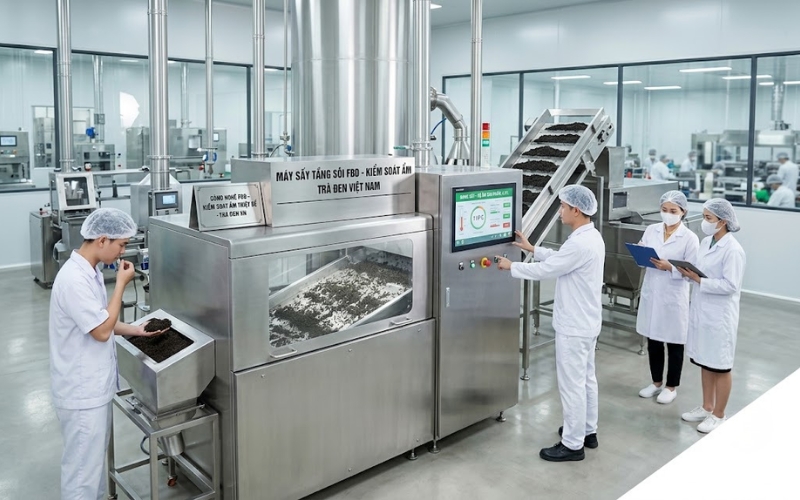
Export processors replace traditional tray dehydrators with continuous Fluidized Bed Dryers (FBD). As each black tea Vietnam lot reaches optimal biochemical fermentation, automated conveyors discharge the tea directly into the fluidization deck. Clean, high-velocity hot air heated to 110°C–130°C blows upward from below, instantly suspending and mixing the tea particles into a continuous boiling state.
This multi-directional convective heat transfer achieves three goals:
- Instant Enzyme Deactivation: Inactivates PPO enzymes within seconds, locking the structural integrity of theaflavins and volatile aromatics.
- Flash Moisture Removal: Evaporates free water rapidly without condensation traps, eliminating sour taints and stewed off-notes.
- Moisture Equilibrium Control: Drives internal moisture safely below 5.5%, preventing post-packaging secondary fermentation and mold growth during maritime shipping.
Standardizing CTC and Orthodox Grades via Electrostatic Separation
Following drying, semi-finished tea enters automated mechanical classification units. Rotary screens and multi-deck deck sifters grade particle sizes according to international screen specs. To strip out fibrous stalk and light contamination, the entire black tea Vietnam stream flows through electrostatic stalk separators and high-speed centrifugal dust extractors.
Charged rotating electrostatic drums lift out light stems and fine debris without crushing tea granules. This machinery isolates precise commercial grades:
- Industrial CTC Grades: Delivers uniform, rounded grades including BP1 (Broken Pekoe 1), PF1 (Pekoe Fannings 1), and PD (Pekoe Dust) with particle size consistency exceeding 98%, clearing out suspended sediment.
- Traditional Orthodox Grades: Retains well-twisted leaf integrity across large-leaf grades including OP (Orange Pekoe) and BOP (Broken Orange Pekoe), serving conventional loose-leaf tea markets.
Custom Contract Wholesale Black Tea Vietnam Supply Capabilities
Because commercial F&B enterprises occupy distinct product spaces and market tiers, a qualified wholesale supplier must serve as a technical solution partner, accommodating precise specifications from R&D divisions and procurement managers.
Custom Blending Services with Locked Sensory Profiles
Rather than limiting clients to static catalog items, the factory provides custom formulation blending matched to individual regional consumer palates:
|
Target Market / Commitment |
Tea Grade / Cut |
Functional Attributes & Applications |
|
Middle East & Eastern Europe |
Orthodox (OP, BOP, FBOP, Pekoe) |
Long, glossy twisted leaves, clear reddish liquor, natural sweetness. Tailored for traditional boiling rituals and Earl Grey flavoring bases. |
|
Taiwan & Southeast Asia |
CTC (BP1, PF1) + Orthodox Fannings |
Elevated tannin concentration, dark red-brown liquor, heavy body. Cuts through non-dairy creamers and pasteurized fresh milk cleanly. |
|
Europe & North America |
Clean CTC Dust/PD & Fannings |
Tailored for high-speed tea bag packaging equipment, soluble instant tea powder extraction, and clean-label RTD beverages. |
|
Profile Consistency Guarantee |
Master Reference Samples & Spectrophotometric Profiling |
Retained laboratory reference samples guarantee that every dispatched shipment of black tea Vietnam maintains a consistent flavor signature over a 3- to 5-year production horizon. |
Flexible MOQ Framework for Pilot and Commercial Phases
Recognizing inventory and financial risks during new product introductions, contract terms support operational agility:
- Lab Bench Trials & Pilot Production Runs: Flexible minimum order quantities ranging from several hundred kilograms up to 1 metric ton provide technical teams with adequate volume for trials on industrial extraction lines.
- Commercial Scaling: Production capacity readily scales to hundreds of metric tons per month under Incoterms 2020 terms (FOB Hai Phong, FOB Cat Lai/Cai Mep, or CIF/CFR to destination discharge ports). Annual framework agreements lock raw material unit pricing against agricultural market swings.
Export Packaging Standards Preserving Freshness Across Ocean Transit
Black tea absorbs ambient moisture and warehouse odors rapidly. Substandard export packaging exposed to 30- to 45-day maritime voyages through equatorial climates will spoil cargo. Packing lines apply strict technical export packaging standards:
- Protective Industrial Packaging: Multi-wall 3- to 4-ply Kraft paper sacks lined with aluminum/PE barrier film (25 kg – 30 kg per bag), or bulk discharge-spout Jumbo sacks (500 kg – 800 kg).
- Maritime Logistics Care: Heat-treated ISPM 15 wooden pallets, paired with high-capacity desiccant bags installed inside shipping containers, ensure that each shipment of black tea Vietnam arrives with moisture contents stabilized below 6%.
- Full Regulatory Export Documentation: Rapid provision of all clearance documentation, including Certificates of Analysis (COA), Phytosanitary Certificates, Fumigation Certificates, and Certificates of Origin (Form A, Form B, Form EUR.1, Form E, Form RCEP) to clear destination customs under preferential tariff schedules.
Partnering with a Reliable Wholesale Black Tea Vietnam Supplier
Standardizing agricultural raw materials forms the foundation for protecting commercial margins, elevating operational efficiency, and scaling across global consumer beverage markets. Through direct capital investments in closed-loop HVAC fermentation chambers, convective fluidized bed dryers, and electrostatic sorting equipment, processing facilities eliminate recurring problems with cold brew turbidity and stewed off-flavors in black tea Vietnam. Rigid lot-by-lot inspection routines and flexible commercial contracting create dependable raw material inputs for industrial bottling and blending lines. To request a laboratory Cupping Sample Kit alongside comprehensive technical Certificate of Analysis (COA/TDS) documentation for any target grade, contact Viet Global Source directly via email at dat.nguyen@vietglobalsource.com. Our international trade and technical food processing specialists stand ready to support your formulation optimization and extraction efficiency throughout your supply operations.